


If only the founder can sell it, it is not a product yet


Most owners can sell their own offer better than anybody they have ever hired. They explain it faster, adjust it on the spot, and know exactly which objection to answer first.
That is usually treated as proof that the founder is irreplaceable. A buyer reads it as proof that the offer is not finished.
Offering is one of six areas that decide what a company is worth. It is not the product. It is the answer to a narrower question: can this be sold by somebody other than you.
Skill and asset are not the same thing
Everything a company knows sits in one of three places, and only one of them is worth anything to a buyer.
In a person's head. It works, often brilliantly, and it walks out of the building at the end of every working life. Nobody can buy it, and nobody can price it.
Written down. Now it can be taught, checked and improved. It is no longer dependent on one memory, and quality stops varying with who was available that week.
Packaged and priced. Now it can be delegated, sold as a defined thing, or licensed to somebody else entirely. This is the only version that appears in a valuation.
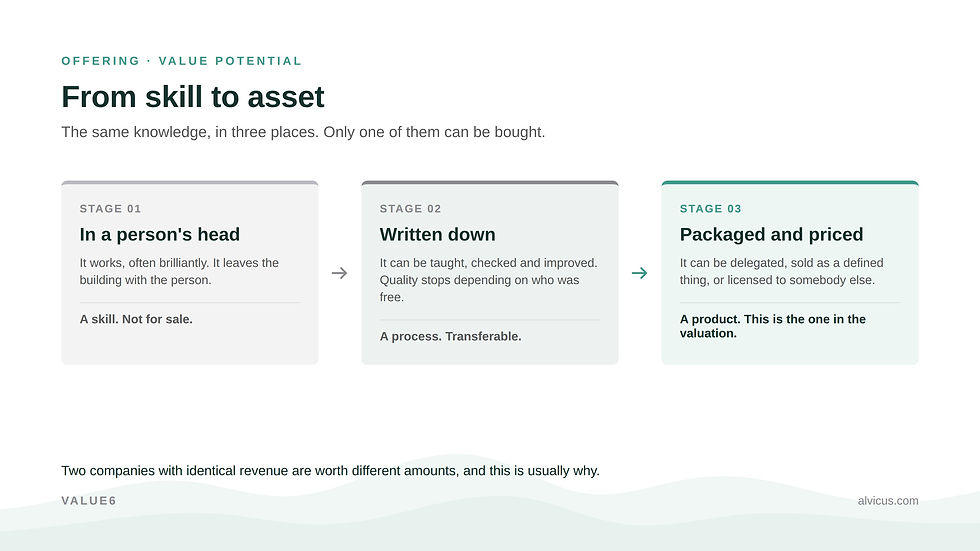
Most owner-led companies have extraordinary knowledge sitting permanently in the first category, and assume that is normal. It is normal. It is also the reason two companies with identical revenue can be worth very different amounts.
Where it usually breaks
Every customer gets something slightly different. It feels like service and behaves like a tax, because nothing repeats and therefore nothing improves. This is where Offering and Scalability meet, and why weakness in one usually means weakness in the other.
The price is invented in the conversation. If the number depends on who is in the room and how the week has gone, there is no price. There is a negotiation, every time, and only one person in the company is good at it.
The explanation changes each time it is given. Ask three people in the company what you sell and why it is better. If the three answers differ, the market hears three different companies.
What a buyer does with this
He is asking one question: after I own this, who sells it?
An offer that only the founder can sell has to be re-taught to a new owner, or the founder has to stay. Both are expensive, and both show up in the price long before anybody says the word risk out loud.
What actually changes it
Write the offer down until somebody else can read it aloud and be convincing. That is the test, and most offers fail it the first time. Not because the offer is bad, but because nobody has ever had to put it into words that work without the founder's tone of voice.
Decide the price before the conversation. A price list is not a loss of flexibility. It is the difference between selling and negotiating, and it lets somebody who is not you close a deal.
Separate what is genuinely custom from what only feels custom. In our experience, most of what owners believe is bespoke is actually the same work, arranged differently for each client. Naming the repeating part is what turns a service into something that can be delegated, packaged, and priced.
We advised the employees of a food company that had become insolvent, on taking over its intellectual property. The operating business could not be saved. What survived was the part that had been written down and registered, because that was the part somebody could actually buy. Everything else disappeared with the entity.
Three questions worth answering tonight
Write the answers down. The exercise only works if you are specific.
Ask three people in your company what you sell and why it is better. How different are the three answers?
What did your last five customers pay, and can you explain the differences without referring to the negotiation?
Which part of your delivery is genuinely different for every client, and which part only looks that way?
One more question
Could a competent stranger sell your offer next week, at your price, without you in the room?
If not, you do not have a product yet. You have a practice, and a practice ends when you do.
From Assessment to Execution
1) A conversation. Thirty minutes, no cost, no deck. You describe the situation, we tell you which of the six is setting your number and whether we are the right people for it.
2) A positioning workshop. Half a day to a full day, CHF 3'950 fixed. You leave with the decisions that move your value, not with a report.
3) Then, if it makes sense for both sides, we stay. A retainer built on the findings, not on a standard package.